AI-ASSISTED ENGINEERING / PROJECT 04
RIPPLE
See the consequences of engineering change.
Explore deterministic graph traversal, cached review findings, and decision traceability in a fictional satellite engineering prototype.
30-SECOND EXECUTIVE BRIEF
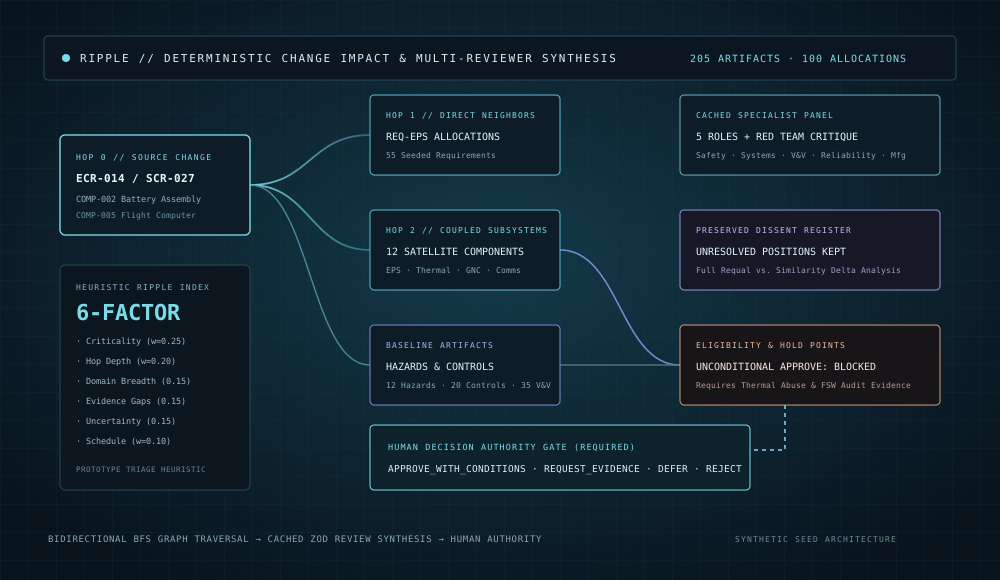
KEY TAKEAWAYS AT A GLANCECombines deterministic breadth-first dependency propagation across a 205-artifact satellite baseline with cached multi-discipline AI review synthesis, preserved reviewer dissent, and human-gated approval workflows.
Engineering Change Requests (ECRs), software upgrades, and qualification waivers often understate their blast radius—invalidating safety evidence or verification items two or three hops away.
Shows how deterministic systems engineering graphs and structured multi-reviewer critique (including an Independent Red Team) can prevent premature change approval while keeping decision authority strictly human.
Change-readiness and assurance workflow design, dissent-preservation model, human authority gating rules, and AI-assisted full-stack prototype architecture.
01 / OVERVIEW
The idea in practice.
An engineering-change impact and readiness prototype that joins typed artifacts, deterministic dependency propagation, cached multidisciplinary review findings, and human decision records.
02 / THE PROBLEM
A real systems question.
A proposed engineering change can affect more than its immediate component. Requirements, interfaces, hazard controls, verification activities, and evidence can become disconnected when reviews are managed in separate documents.
03 / MY APPROACH
Make the reasoning inspectable.
Represent the baseline as typed artifacts and relationships. Use breadth-first traversal to expose reachable artifacts and explicit paths, calculate a heuristic RIPPLE Index in the original application, and organize cached review findings and dissent around a human decision workflow.
Portfolio contribution context: domain-led concept development and AI-assisted prototyping, as described by the owner. Individual implementation authorship is not documented in the supplied files.
04 / SYSTEM ARCHITECTURE
From inputs to insight.
Select any stage below to inspect its inputs, state transformations, outputs, and failure/uncertainty handling:
Project Ripple/packages/server/src/seed/ · packages/shared/55 requirements, 12 components, 16 interfaces, 12 hazards, 20 critical controls, 12 failure modes, 35 verification & 25 evidence items
Validates artifact types, domain ownership, and 100 seeded ALLOCATED_TO edges through shared @ripple/shared Zod schemas
Queryable relational baseline in SQLite (local app) and 67-node in-memory graph (browser adaptation)
Rejects malformed review payloads via strict Zod schema parsing before storage or UI rendering
Algorithms & Engineering Logic
Bidirectional Breadth-First Dependency Propagation (propagateImpact)
Project Ripple/packages/server/src/engine/propagation.ts#L49-L151BFS over G = (V, E_outgoing ∪ E_incoming) up to depth ≤ maxHops, recording path[0..k] per visited nodeTraverses both outgoing and incoming AUTHORITATIVE / ACCEPTED relationships from the starting component, classifying hop 1 neighbors as DIRECT and hop 2..maxHops as INDIRECT, and mapping each artifact type to a specific verification or safety re-evaluation action.
Six-Factor Weighted Heuristic RIPPLE Index
Project Ripple/packages/server/src/engine/propagation.ts#L161-L205Index = round(∑ w_i · S_i) ∈ [0, 100] over Criticality, Depth, Breadth, Evidence Gaps, Uncertainty, ScheduleCombines artifact criticality weights (Hazard 90, Critical Control 85, Failure Mode 70, Requirement 60, Component 55), hop depth (max×20 + avg×30), domain breadth (domains×15), verification/evidence density, and indirect uncertainty into a prototype triage score.
Multi-Reviewer Dissent Preservation & Decision Eligibility Gate
Project Ripple/packages/server/src/demo/cached-reviews/ecr-014/round-4-chair-synthesis.jsoneligible(APPROVE) = false if ∃ unresolved BLOCKER finding or invalidated safety hazard closureStructures specialist reviews (Safety, Systems, V&V, Reliability, Manufacturing) and Red Team critique into unanimous agreements, explicit unresolvedDissent (with competing positions and evidenceToResolve), and gated decision options.
Architectural Decisions & Engineering Trade-Offs
Deterministic graph traversal before AI review synthesis
Guarantees that explicit requirement and component allocations are traced reproducibly rather than relying on an LLM to guess system topology.
Traversal usefulness is bounded by baseline graph fidelity; the supplied seed uses 100 generated requirement-to-component edges with placeholder requirement titles.
Cached schema-validated review fixtures vs. live API calls in the portfolio demo
Allows visitors to inspect realistic multi-reviewer dissent and human decision gating immediately in the browser without API keys or a Node/SQLite backend.
Live AI provider mode is unimplemented in the source repo, and the original evaluation screen percentages are hardcoded UI fixtures excluded from portfolio claims.
Verification, Testing & Evidence Scope
Exact reproduction of the 12 component IDs, 55 requirement IDs, 100 generated ALLOCATED_TO edges, bidirectional BFS reachability counts, and cached Chair Synthesis records.
Deterministic path traceability, exact graph reachability math, and transparent separation of cached review fixtures from live inference.
Does not establish live LLM accuracy, real satellite qualification status, or production role-based access security.
HANDS-ON EXPLORATION
Follow the ripple effect & review synthesis.
Browser adaptation · synthetic seed data · no live AI review. Highlighting computes reachability through generated requirement-to-component allocations; it does not establish a verified engineering impact.
Loading graph & review explorer…
05 / RESULTS & CAPABILITIES
What the project does.
- Typed baseline with three fictional change scenarios and recorded graph paths.
- Deterministic traversal and a six-component heuristic RIPPLE Index in the original application.
- Cached review findings, preserved dissent, human decision recording, and audit history.
- JSON and Markdown exports in the original local application.
06 / ENGINEERING CHALLENGES
Where the hard questions are.
- Preserving a traceable graph path for each reachable artifact.
- Distinguishing graph reachability from a substantiated engineering impact.
- Keeping human decision authority visible in an AI-assisted workflow.
Current boundaries
- The 100 seed relationships are generated requirement-to-component allocations; requirement titles are placeholders, not a validated cross-domain architecture.
- Live AI provider mode throws; current reviews use cached fixtures.
- Cross-examination is a pass-through and the evaluation runner is a placeholder.
- Evaluation percentages in the original interface are fixtures, not measured performance.
- The original application requires a local server and database and has no production authentication.
07 / FUTURE DEVELOPMENT
The next useful steps.
- 01Implement and evaluate live provider adapters.
- 02Replace fixture evaluation screens with a reproducible evaluation suite.
- 03Add authenticated decision roles and stronger provenance records.
08 / AI DEVELOPMENT TRANSPARENCY
Tools, judgment, and evidence.
The portfolio owner uses ChatGPT, Claude, and Google Antigravity for concept development, design, and prototyping. Project-specific records do not establish which tool or person authored individual components. No precise human/AI coding split is claimed.
The capabilities described here were checked against supplied source files. Model behavior, cached examples, historical data, and proposed features are identified separately.
Source evidence
Project Ripple/packages/server/src/engine/propagation.tsProject Ripple/packages/server/src/ai/provider-adapter.tsProject Ripple/packages/server/src/seed/Project Ripple/packages/server/src/demo/cached-reviews/
Local source references for provenance; confidential materials are not distributed.
AV / CITY
Interrogate the evidence behind autonomy.
THE NEXT CONVERSATION
Let’s work on
what comes next.
Technical programs. Systems assurance. Intelligent technology.
Complex problems with a practical purpose.