DIGITAL TWINS & ASSURANCE / PROJECT 02
POSEIDON
Making mission assurance observable.
Connect synthetic underwater telemetry to sensor confidence, diagnostic evidence, hazards, and explainable mission recommendations.
30-SECOND EXECUTIVE BRIEF
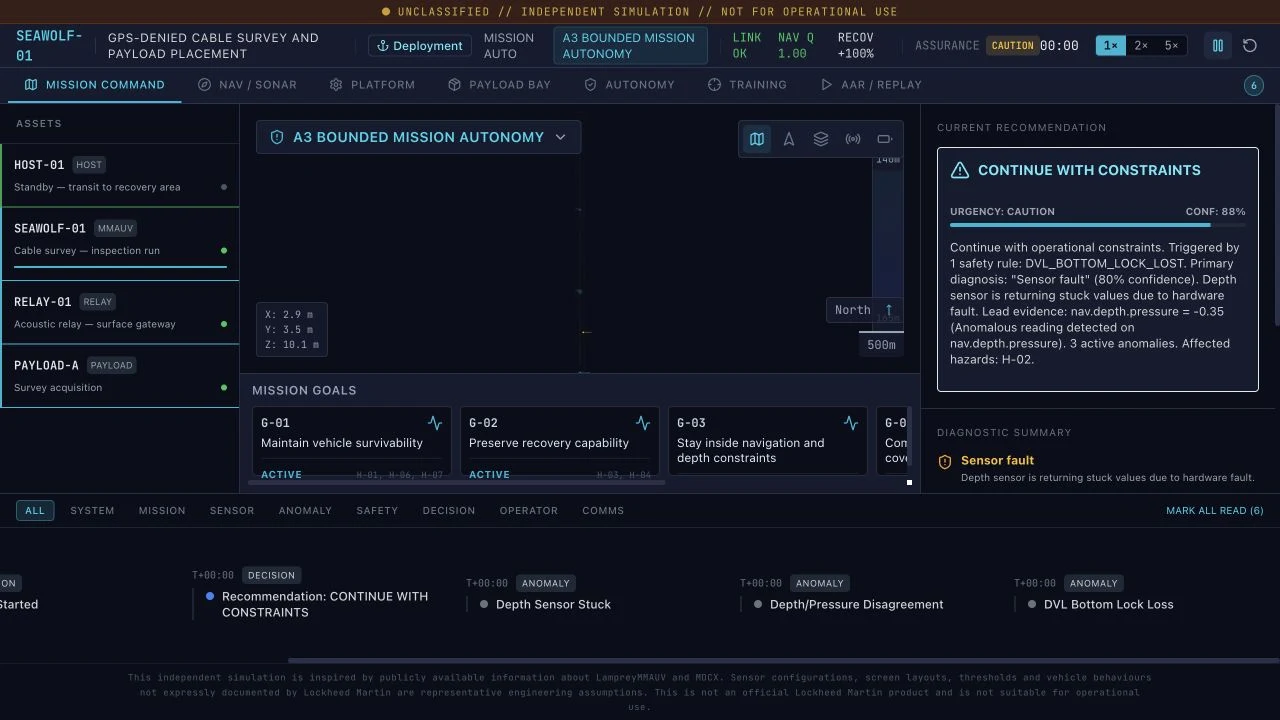
KEY TAKEAWAYS AT A GLANCESimulates an autonomous underwater vehicle (AUV) subsea inspection workstation across 7 operational views, 47 synthetic sensors, multi-sensor fusion with confidence bounds, and 7 injectable fault scenarios.
In GPS-denied, communications-constrained environments, operators cannot rely on raw telemetry values alone; they need to see sensor agreement, estimate uncertainty, and which critical controls are degraded.
Demonstrates a 4-level progressive disclosure architecture (Observation → Anomaly → Hazard/Control → Recommendation) that makes autonomous mission assurance inspectable and auditable.
Mission-assurance architecture, separation of ground-truth state from FusedEstimate<T> displays, provenance labeling discipline, hazard/control register linking, and AI-assisted React/TypeScript development.
01 / OVERVIEW
The idea in practice.
An underwater mission-assurance interface that traces a simulated vehicle’s state through sensors, fusion, anomaly detection, hazard assessment, and rule-based decision support.
02 / THE PROBLEM
A real systems question.
A dashboard can show a healthy-looking number while obscuring a degrading sensor or an uncertain estimate. Mission assurance needs the evidence behind system health and the reasoning behind a recommendation.
03 / MY APPROACH
Make the reasoning inspectable.
Build a layered, seeded simulation pipeline. Keep vehicle truth, sampled measurements, fused estimates, diagnostic evidence, and operator decisions as distinct concepts so the interface can reveal their relationships.
Portfolio contribution context: domain-led concept development and AI-assisted prototyping, as described by the owner. Individual implementation authorship is not documented in the supplied files.
04 / SYSTEM ARCHITECTURE
From inputs to insight.
Select any stage below to inspect its inputs, state transformations, outputs, and failure/uncertainty handling:
POSEIDON/src/core/simulation/SimulationEngine.ts · SeededRandom.tsMulberry32 PRNG seed, Arctic under-ice depth profile, 4-thruster kinematics, and 2400 Wh battery assumption
Fixed-timestep simulation of vehicle truth position, attitude, thermal state, hydrogenerator recharge, and 24 ft³ payload bay load
Ground-truth vehicle & environment state (isolated from operator navigation displays)
Maintains deterministic repeatability across identical seeds; labels every parameter with explicit provenance tags
Algorithms & Engineering Logic
FusedEstimate<T> Confidence & Uncertainty Separation
POSEIDON/src/core/fusion/FusionEngine.ts · DepthFusion.ts · NavigationFusion.tsFusedEstimate<T> = { value: T, confidence: [0..1], uncertainty: number, sources: SensorId[], provenance: ProvenanceTag }Enforces an architectural boundary between simulated vehicle truth and operator displays. DepthFusion and NavigationFusion combine noisy sensor samples, penalizing confidence and expanding uncertainty bounds when DVL drift or pressure-sensor freeze increases cross-channel residuals.
Four-Level Progressive Disclosure Diagnostic Chain
POSEIDON/src/core/anomaly/DiagnosticEngine.ts · src/core/decision/DecisionEngine.tsSensorSample → AnomalyRule (threshold/variance) → DiagnosticHypothesis (EvidenceCollector) → Hazard/Control → RecommendationInstead of emitting opaque alerts, each recommendation links back to the specific anomaly rule triggered, the supporting sensor history, the affected entry in HazardRegister (e.g., under-ice navigation loss or thermal fade), and the mitigating ControlRegister item.
Seeded Mulberry32 PRNG & Seven-Scenario Fault Injection
POSEIDON/src/core/simulation/SeededRandom.ts · src/core/fault/ScenarioRegistry.tss = (s + 0x6D2B79F5) | 0 ; deterministic fault modifiers applied at SensorSampler layerUses a seeded 32-bit PRNG so sensor noise and environmental variations are reproducible across test runs, allowing the 7 fault scenarios (Depth Sensor Stuck, DVL Drift, Thruster Fouling, Battery Degradation, Comms Loss, Host Recharge Underperformance, Payload Degradation) to be verified deterministically.
Architectural Decisions & Engineering Trade-Offs
Explicit rule-based diagnostic & decision engine vs. black-box ML classifier
Safety-critical mission assurance requires every recommendation to be traceable to explicit sensor evidence, thresholds, and hazard controls.
Rules cover only the modeled fault modes and do not generalize automatically to unmodeled physical interactions.
Recording operator recommendations & autonomy levels vs. closed-loop vehicle re-routing
Demonstrates human-on-the-loop supervisory governance, acknowledgement logging, and provenance clarity in a browser workstation.
Autonomy level selection (A0–A4) and recommendation overrides update state and audit logs but do not alter the simulated vehicle trajectory; some AAR summary fields and schematic zone badges remain illustrative.
Verification, Testing & Evidence Scope
Seeded PRNG determinism, 47-sensor sampling, fault injection modifiers, depth/nav fusion confidence degradation, anomaly detection, diagnostic evidence collection, and decision engine rules.
Verified execution of the layered simulation-to-decision pipeline and deterministic fault detection within the software model.
Does not validate real subsea acoustics, hydrodynamic vehicle performance, hardware integration, or operational safety.
HANDS-ON EXPLORATION
Explore the interactive lab & working prototype.
Independent educational concept using synthetic telemetry and representative assumptions. Some report summaries are illustrative. No operational control, field validation, certification, or manufacturer endorsement.
Interactive Fault Injection & Assurance Trace Explorer
Inspect how POSEIDON’s rule-based engine (POSEIDON/src/core/) separates simulated vehicle truth from uncertain sensor estimates across all 7 training fault scenarios. Select a fault scenario below or launch the full 7-workspace workstation underneath.
Select Injected Training Fault Scenario (7)
A2 Bounded Execution — System manages nominal survey tracking; human approves fault re-tasking. (Note: In the current prototype, selecting an authority level updates presentation state and decision logs without closed-loop vehicle route execution.)
05 / RESULTS & CAPABILITIES
What the project does.
- Seven injected fault scenarios, including depth-sensor, communication, and energy degradation.
- Sensor-health tracking, fused estimates, anomaly evidence, and diagnostic rules.
- Explainable recommendations linked to hazards and degraded controls.
- In-session event, action, and recommendation exports.
06 / ENGINEERING CHALLENGES
Where the hard questions are.
- Distinguishing simulated truth from uncertain sensor estimates.
- Connecting diagnostic observations to the relevant assurance controls.
- Keeping an operator’s recorded decision separate from actual vehicle execution.
Current boundaries
- Replay playback is not implemented; event selection works.
- Some AAR summary values and platform-ready indicators are illustrative.
- Autonomy selection and recorded recommendations do not execute vehicle control.
- 56 tests pass across 19 files, within the simplified software model.
07 / FUTURE DEVELOPMENT
The next useful steps.
- 01Replace illustrative summaries with computed session measures.
- 02Implement deterministic replay of full session state.
- 03Connect autonomy policy to explicit, testable simulated control actions.
08 / AI DEVELOPMENT TRANSPARENCY
Tools, judgment, and evidence.
The portfolio owner uses ChatGPT, Claude, and Google Antigravity for concept development, design, and prototyping. Project-specific records do not establish which tool or person authored individual components. No precise human/AI coding split is claimed.
The capabilities described here were checked against supplied source files. Model behavior, cached examples, historical data, and proposed features are identified separately.
Source evidence
POSEIDON/README.mdPOSEIDON/src/hooks/useSimulationOrchestrator.tsPOSEIDON/src/core/POSEIDON/src/components/aar/AARReplayView.tsx
Local source references for provenance; confidential materials are not distributed.
DRILL SENTINEL
Drilling evidence, with the context intact.
THE NEXT CONVERSATION
Let’s work on
what comes next.
Technical programs. Systems assurance. Intelligent technology.
Complex problems with a practical purpose.