INDUSTRIAL SYSTEMS / PROJECT 03
DRILL SENTINEL
Drilling evidence, with the context intact.
Replay real historical drilling measurements, inspect explainable indicators, and connect uncertainty to assurance questions and separate what-if scenarios.
Historical data: Equinor ASA and former Volve licence partners ExxonMobil Exploration & Production Norway AS and Bayerngas Norge AS. Public normalized mirror: Sky370 / DrillDash. The supplied derivative declares CC BY-NC-SA 4.0 alongside Equinor terms; this is a noncommercial evaluation demonstration. Attribution and source licences remain in the original application pack. No operator or data-provider endorsement.
30-SECOND EXECUTIVE BRIEF
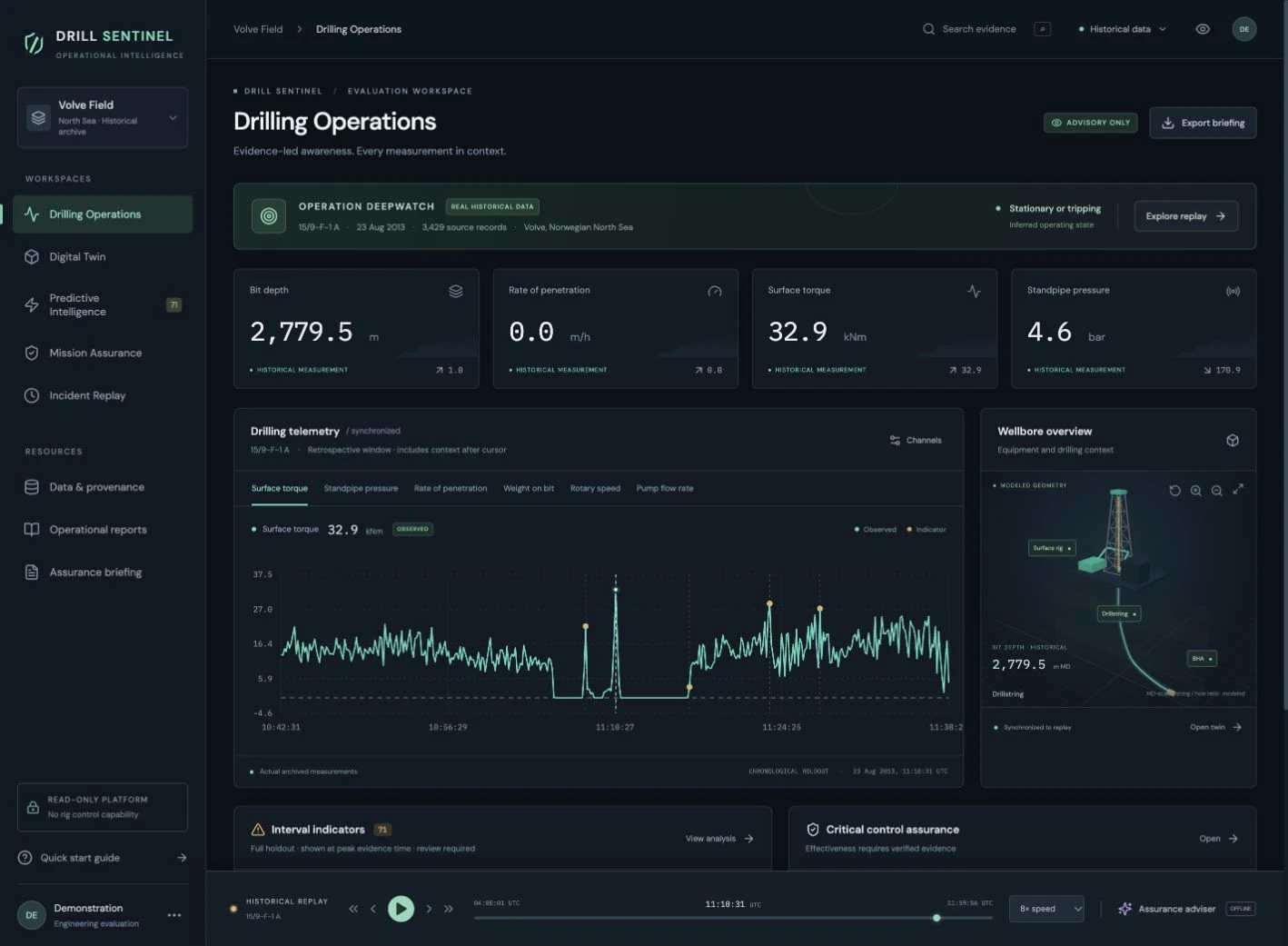
KEY TAKEAWAYS AT A GLANCEReplays 3,429 time-aligned historical Volve drilling observations (23 Aug 2013, Well 15/9-F-1 A), pairs them with SHA-256-verified statistical departure indicators, links findings to 4 illustrative bowties and 6 critical controls, and provides an isolated hydraulic/ROP what-if simulator.
Industrial monitoring tools often fire context-free threshold alarms or opaque black-box predictions without showing whether a signal shift reflects an operating-regime change, a sensor quality issue, or an unverified barrier.
Demonstrates how high-consequence drilling and energy operations can combine statistical monitoring with critical-control assurance—preserving data lineage, missing-evidence flags, and strict read-only safety guardrails.
Operational risk and drilling-assurance framing, separation of measured evidence from hypothetical what-if branches, critical-control verification structure (CC-01 to CC-06), and AI-assisted full-stack prototyping across Python and TypeScript.
01 / OVERVIEW
The idea in practice.
An evidence-led drilling intelligence workspace built around Operation Deepwatch, an eight-hour historical Volve interval. It joins source-time replay, synchronized telemetry, statistical evidence, a modeled rig, illustrative critical controls, and isolated scenario branches. Data is credited to Equinor ASA and former Volve licence partners ExxonMobil Exploration & Production Norway AS and Bayerngas Norge AS; public mirror conversion is credited to Sky370 / DrillDash. No operator endorsement is implied.
02 / THE PROBLEM
A real systems question.
An unusual trend is not enough to establish a physical drilling problem. Measurements need operating context, sensor-quality information, traceable references, and independent control evidence. This project explores how to expose that context without turning a statistical indicator into an unsupported diagnosis or operational instruction.
03 / MY APPROACH
Make the reasoning inspectable.
Preserve the historical observations and their lineage. Generate a frozen, chronological analysis snapshot using context-conditioned robust references, then let visitors trace indicators back to records and inspect what remains unknown. Keep modeled geometry, retrospective context, inferred operating states, and hypothetical changes visibly distinct from measured evidence.
Portfolio contribution context: domain-led concept development and AI-assisted prototyping, as described by the owner. Individual implementation authorship is not documented in the supplied files.
04 / SYSTEM ARCHITECTURE
From inputs to insight.
Select any stage below to inspect its inputs, state transformations, outputs, and failure/uncertainty handling:
backend/sentinel/ingestion.py · public/data/quality-profile.json190,995 source parquet rows → 3,429 selected 8-hour interval observations + 14 WITSML messages + survey stations
Unit normalization (N·m → kN·m, Pa → bar, m³/s → L/min, c/s → rpm) and quality screening (observed, suspect, missing)
Versioned telemetry.json, trajectory.json, reports.json, and quality-profile.json with SHA-256 manifest
Missing/suspect channels (e.g., constant 1,280 kg/m³ mud density) are flagged and excluded from false diagnostic claims
Algorithms & Engineering Logic
Context-Conditioned Robust Departure Scoring (Median / MAD)
Drill Sentinel/src/logic.ts#L25-L39 · backend/sentinel/analytics.pyscale = max(1.4826 × MAD, 0.02 × |median|, channel_floor) ; score = |x_t − median_ctx| / scale_ctxFits reference baselines strictly on the first 60% of observations chronologically, partitioned by heuristic operating state (rotary_drilling, rotating, circulating, stationary_or_tripping) and RPM or pump-flow bucket (requiring n ≥ 16 samples). Engineering scale floors (torque 0.3 kN·m, SPP 3 bar, ROP 1 m/h, WOB 5 kN, hookload 10 kN) prevent near-zero variance regimes from inflating minor noise.
Isolated What-If Hydraulic & Response Sensitivity Model
Drill Sentinel/src/logic.ts#L50-L68 · backend/sentinel/simulation.pyP_modeled = SPP_obs × (flow_factor)² × density_factor ; ROP_idx = (WOB_factor)^0.6 × (RPM_factor)^0.3 × equip_avail × 100Evaluates bounded parameter perturbations (WOB, RPM, flow 50–150%; mud density 80–130%) and subsystem availability hypotheses without altering historical observations. Computes an assurance review-priority score (base 30 pts for unknown barrier, 65 pts for degraded barrier, +20 sensor, +15 comms, +15 equipment, capped at 100).
Cursor-Bounded Deterministic Evidence Adviser & Command Guardrail
Drill Sentinel/src/logic.ts#L69-L96 · backend/sentinel/adviser.pyvisible_alerts = alerts.filter(a => Date.parse(source.timestamp) <= cursor_time && a.index <= cursor_index)Resolves quoted values strictly from source records at or before the active replay cursor so future holdout peaks are never leaked into an earlier timestamp inspection. Rejects any prompt matching /shut-in|choke|kill mud|bop sequence|pump command|setpoint/ with an explicit safety boundary notice.
Architectural Decisions & Engineering Trade-Offs
Frozen 60/40 chronological median/MAD baseline vs. adaptive black-box anomaly detection
Every flagged indicator can be audited down to its exact training median, MAD scale, sample count, and operating state without hidden neural weights.
When later drilling intervals shift into new operating regimes, a static 2.0-scale-unit threshold flags 77.04% of held-out rows (226 episodes), demonstrating why regime adaptation and verified incident labels are required before operational deployment.
Defaulting all six critical controls (CC-01 to CC-06) to UNKNOWN status
Surface telemetry alone cannot prove that a physical barrier test was signed, a mud balance was reconciled, or a shift handover occurred.
Prevents reassuring "green" compliance dashboards, forcing reviewers to distinguish sensor observations from independent barrier verification.
Static snapshot browser verification vs. mandatory live Python backend
Allows the full analytical replay and assurance workbench to run reliably in a browser from SHA-256-verified JSON snapshots without requiring a live database server.
Custom file ingestion, SQLite append-only audit persistence, and live WebSocket streaming require running the separate FastAPI backend service.
Verification, Testing & Evidence Scope
Missing/suspect quality gates, chronological split integrity, robust MAD scale floors, isolated scenario bounds, cursor-restricted adviser citations, and Python-to-TypeScript snapshot parity.
Mathematical parity between Python and TypeScript implementations, immutability of historical observations during what-if branches, and strict adherence to replay-cursor chronology.
Does not establish real-world incident prediction accuracy, false-alarm rates, downhole physical failure causation, or suitability for live rig control.
HANDS-ON EXPLORATION
Explore the Deepwatch workbench & historical prototype.
Read-only historical-data evaluation with separately labeled hypothetical scenarios. The adviser uses offline evidence retrieval; no live LLM, rig control, field validation, or safety certification. The original private workspace opens separately and may require owner sign-in; an interactive browser workbench is also embedded below.
Loading Drill Sentinel assurance workbench…
05 / RESULTS & CAPABILITIES
What the project does.
- Source-time replay of 3,429 actual historical observations, with synchronized telemetry, record identifiers, timestamps, and quality flags.
- Dataset SHA-256 and record-count verification before associating the Python analysis snapshot with browser measurements.
- Explainable statistical indicators with frozen training references, traceable evidence, and alternative explanations.
- Interactive modeled rig alongside a separate chart of actual supplied survey stations, with their time availability made explicit.
- Four illustrative bowties, six controls with unknown effectiveness, isolated what-if branches, offline cited summaries, and briefing export.
06 / ENGINEERING CHALLENGES
Where the hard questions are.
- Preserving missing, suspect, and original supplied values through normalization and display.
- Keeping training references chronological and preventing an adviser from citing evidence after the selected replay cursor.
- Separating statistical abnormality, modeled response, and control-verification needs from validated physical conclusions.
Current boundaries
- No verified incident labels support prediction accuracy, false-alarm rate, calibrated risk, or incident lead-time claims. At the bundled exploratory threshold, 77.04% of held-out rows are flagged; useful warning and reduced review burden are unproven.
- The rig and well-path depiction are illustrative. Operating states are inferred, and control effectiveness remains unknown without appropriate independent evidence.
- The adviser is deterministic local retrieval and templates, with no external generative model. Live WITSML/ETP connectivity is disabled and untested.
- The optional FastAPI/SQLite service is a localhost prototype. Enterprise identity, tamper-resistant audit, field validation, and operational acceptance are not established.
- The supplied normalized data derivative declares CC BY-NC-SA 4.0 alongside Equinor terms. The original source pack retains attribution and licence notices for noncommercial evaluation; this portfolio does not duplicate its raw dataset.
07 / FUTURE DEVELOPMENT
The next useful steps.
- 01Validate source identity, sensor context, and annotation quality before a blinded multiwell evaluation.
- 02Test an authorized read-only industrial interface, authenticated review roles, and durable audit retention.
- 03Evaluate thresholds, uncertainty communication, and intended-user workflows with qualified domain reviewers.
08 / AI DEVELOPMENT TRANSPARENCY
Tools, judgment, and evidence.
The portfolio owner uses ChatGPT, Claude, and Google Antigravity for concept development, design, and prototyping. Project-specific records do not establish which tool or person authored individual components. No precise human/AI coding split is claimed.
The capabilities described here were checked against supplied source files. Model behavior, cached examples, historical data, and proposed features are identified separately.
Source evidence
DRILL SENTINEL/README.md — retained source packageDRILL SENTINEL/src/App.tsx and src/logic.tsDRILL SENTINEL/backend/sentinel/analytics.py and ingestion.pyDRILL SENTINEL/docs/DATA_PROVENANCE.md and VALIDATION.mdDRILL SENTINEL/tests/frontend.test.mjs
Local source references for provenance; confidential materials are not distributed.
RIPPLE
See the consequences of engineering change.
THE NEXT CONVERSATION
Let’s work on
what comes next.
Technical programs. Systems assurance. Intelligent technology.
Complex problems with a practical purpose.