AUTONOMOUS SYSTEMS / PROJECT 01
NORTHSTAR
A proving ground for autonomous decisions.
Explore the relationship between perception, road conditions, and vehicle response in a reproducible 3D driving environment.
30-SECOND EXECUTIVE BRIEF
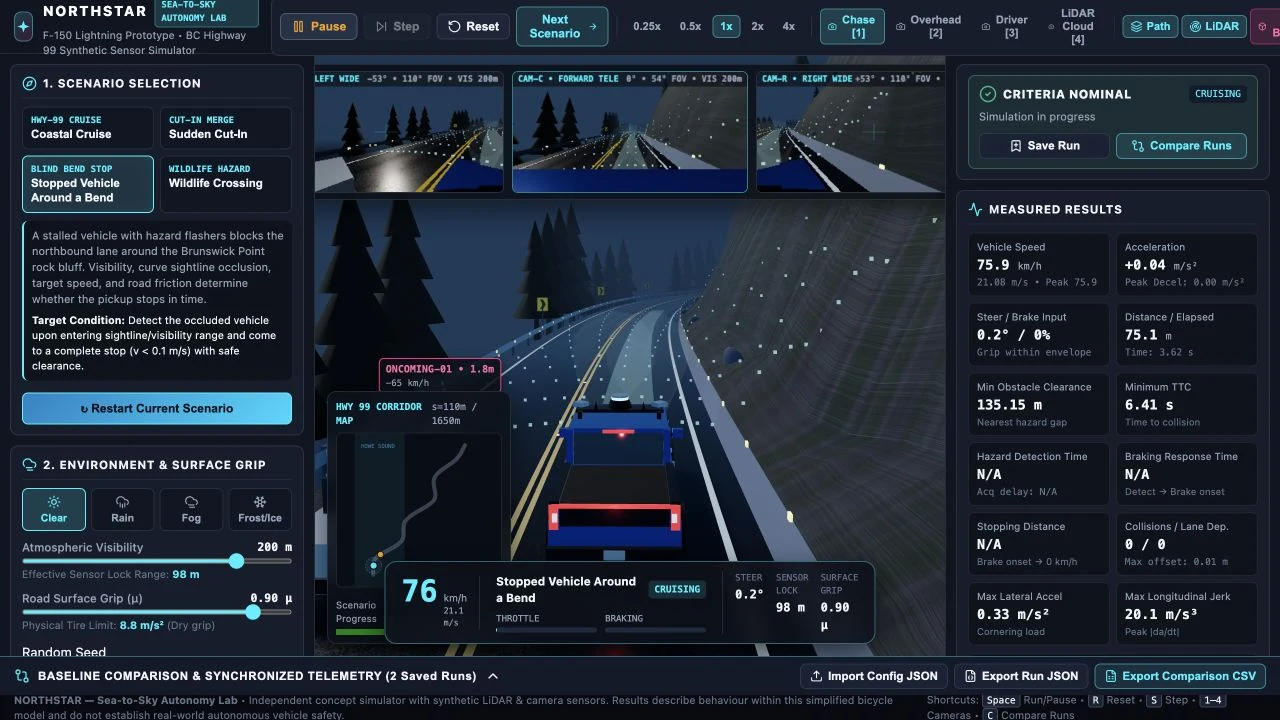
KEY TAKEAWAYS AT A GLANCESimulates an autonomous vehicle along a 1.65 km stylized Sea-to-Sky Highway corridor with configurable weather, road friction, curve sightlines, and hazard timing across 4 driving scenarios.
Visual autonomy demos often obscure why a controller succeeded or failed. Northstar exposes the exact coupling between optical visibility, curve sightline limits, confirmation latency, and tire friction limits.
Shows how systems assurance and scenario-based verification can be built into interactive autonomy tools—allowing engineers and leaders to compare runs deterministically.
Scenario definition, operational safety envelope framing (sightline vs. friction stopping margins), telemetry/comparison workflow design, and AI-assisted implementation in TypeScript and Three.js.
01 / OVERVIEW
The idea in practice.
A browser-based autonomy laboratory set along a stylized Sea-to-Sky Highway corridor. Configure a scenario, watch a simulated vehicle respond, and examine the telemetry and event trail behind its behavior.
02 / THE PROBLEM
A real systems question.
A polished autonomous-driving visualization can hide the decisions that matter. This project makes the effects of visibility, road grip, hazard timing, and controller settings inspectable within a simplified mathematical model.
03 / MY APPROACH
Make the reasoning inspectable.
Separate the fixed-timestep simulation from its visual presentation. Use seeded scenarios to make runs reproducible, then connect controls, sensor overlays, event snapshots, and comparison views to the same simulation state.
Portfolio contribution context: domain-led concept development and AI-assisted prototyping, as described by the owner. Individual implementation authorship is not documented in the supplied files.
04 / SYSTEM ARCHITECTURE
From inputs to insight.
Select any stage below to inspect its inputs, state transformations, outputs, and failure/uncertainty handling:
Northstar/src/sim/presets.ts · roadGeometry.tsScenario preset (Coastal Cruise, Sudden Cut-In, Stopped Vehicle Around a Bend, Wildlife Crossing), seed, weather, μ, controller gains
Generates deterministic traffic spawns, 1.65 km Highway 99 centerline spline, elevation profile, and bend sightline constraints
Immutable SimulationConfig passed to the fixed-timestep physics engine
Validates parameter bounds and resets seed state so repeated runs at 0.25x–4x speed remain bit-identical
Algorithms & Engineering Logic
Visibility & Sightline-Attenuated Detection Horizon (D_eff)
Northstar/src/sim/simulationEngine.ts · Northstar/README.mdD_eff = min(detectionRangeM, visibilityM × (1 − 0.14 × precipitation), bendSightlineLimitM)Models how nominal sensor range is simultaneously bounded by atmospheric extinction (fog and precipitation) and physical road-curve occlusion (granite bluff around Brunswick Point). When a hazard enters D_eff, a confirmation timer (0.14s in clear air up to 0.24s in dense fog) elapses before full AEB braking engages.
Curvature-Preview Speed Regulation & Stanley Lateral Tracking
Northstar/src/sim/simulationEngine.tsv_curve_max = sqrt(min(a_lat_comfort, 0.72 × μ × g) / max(|κ(s)|, 1e-4)) ; δ = atan2(k_y · e_y, v) + ψ_ePreviews road curvature κ(s) ahead of the vehicle to reduce cruising speed before entering sharp bends, while tracking the +1.85 m northbound lane center with steering angle (|δ| ≤ 30°) and rate (|dδ/dt| ≤ 0.75 rad/s) limits.
Fixed-Timestep (50 Hz) Deterministic Integration & Run Comparison
Northstar/src/sim/simulationEngine.test.tsΔt = 0.02 s fixed step ; d_stop = v · t_confirm + v² / (2 · min(a_brake_max, μ · g))Advances physics in discrete 20 ms increments independent of `requestAnimationFrame` timing or playback speed multiplier (0.25x–4x), guaranteeing identical collision, TTC, and stopping-distance metrics across repeat runs.
Architectural Decisions & Engineering Trade-Offs
Geometric visibility & sightline perception vs. neural network vision model
Makes the causal relationship between sightline distance, fog attenuation, confirmation delay, and tire grip mathematically transparent and 100% reproducible in browser JavaScript.
Does not model camera glare, false-positive bounding boxes, or ML classification uncertainty.
Planar kinematic/dynamic bicycle model with friction limit vs. multi-body suspension
Sustains real-time 50 Hz stepping alongside a procedural Three.js scene without external physics engines.
Omits pitch/roll weight transfer, tire slip-angle relaxation, and wheel-by-wheel ABS modulation.
Verification, Testing & Evidence Scope
Fixed-timestep determinism across playback speeds, coastal cruise lane keeping, sudden cut-in response, stopped vehicle bend braking, and wildlife crossing metrics.
Reproducible state transitions, deterministic metric calculation, and expected controller response within the simplified software model.
Does not establish real-world vehicle safety, sensor performance, hardware-in-the-loop timing, or regulatory certification.
HANDS-ON EXPLORATION
Explore the interactive lab & working prototype.
Independent concept simulator. Synthetic sensors and simplified vehicle dynamics. Results apply only to this model and do not establish real-world vehicle safety.
Loading interactive parameter lab…
05 / RESULTS & CAPABILITIES
What the project does.
- Four configurable driving scenarios, including cut-in, stopped vehicle, and wildlife crossing.
- Four camera modes and synthetic LiDAR, planned-path, and detection-box overlays.
- Saved-run comparison with telemetry and timestamped event snapshots.
- JSON/CSV export and configuration import for reproducible exploration.
06 / ENGINEERING CHALLENGES
Where the hard questions are.
- Preserving identical physics when playback speed changes.
- Making road curvature, visibility, friction, and braking interact coherently.
- Keeping rendered sensor overlays distinct from measured or learned perception.
Current boundaries
- Sensors are geometric constructions; there is no trained perception model.
- Vehicle dynamics are simplified; no real vehicle or hardware-in-the-loop validation is supplied.
- Six source tests pass; they verify selected model behavior, not operational safety.
07 / FUTURE DEVELOPMENT
The next useful steps.
- 01Calibrate model assumptions against documented reference data.
- 02Expand parameter sweeps and regression scenarios.
- 03Add clearer uncertainty bounds and richer tire dynamics.
08 / AI DEVELOPMENT TRANSPARENCY
Tools, judgment, and evidence.
The portfolio owner uses ChatGPT, Claude, and Google Antigravity for concept development, design, and prototyping. Project-specific records do not establish which tool or person authored individual components. No precise human/AI coding split is claimed.
The capabilities described here were checked against supplied source files. Model behavior, cached examples, historical data, and proposed features are identified separately.
Source evidence
Northstar/README.mdNorthstar/src/sim/simulationEngine.tsNorthstar/src/render/SeaToSkySceneManager.tsNorthstar/src/sim/simulationEngine.test.ts
Local source references for provenance; confidential materials are not distributed.
POSEIDON
Making mission assurance observable.
THE NEXT CONVERSATION
Let’s work on
what comes next.
Technical programs. Systems assurance. Intelligent technology.
Complex problems with a practical purpose.